From information chaos to an
intelligent portfolio.
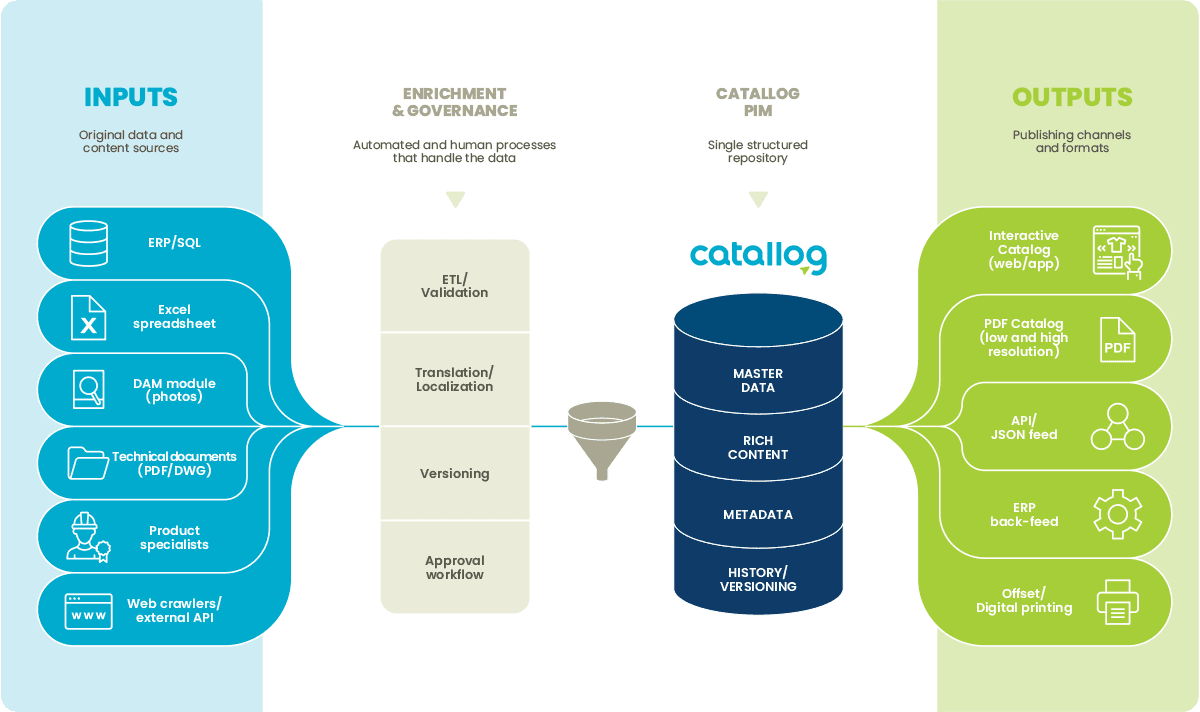
Catallog combines PIM and Knowledge Management so industries, distributors, and retailers can control, standardize, and distribute product information with technical rigor.

Recognize this scenario?
Most companies lose time and money with decentralized, inconsistent, and hard-to-update product information.
Scattered data
Technical sheets in spreadsheets, PDFs, emails, and disconnected systems. Nobody knows which version is current.
Outdated catalogs
Commercial materials and e-commerce with conflicting information, generating errors in proposals and customer dissatisfaction.
Constant rework
Every product update requires manual revision across multiple channels. Overloaded teams, rising costs.
Information chaos
Spreadsheets · PDFs · rework · inconsistencies
Intelligent portfolio
Single source · automatic updates · governance
A platform focused on the full intelligent catalog lifecycle
PIM fundamentals combined with Knowledge Management principles.
PIM — Data governance
Centralization, taxonomic standardization, and quality control of product attributes.
Catalog automation
Automatic generation of digital and print catalogs with instant updates across all formats.
Knowledge base
Technical documentation, certifications, and integrated multimedia — institutional memory of the portfolio.
For those who treat products as knowledge assets
Catallog serves organizations that need to communicate products with precision, coherence, and strong governance.
Manufacturers
Technical products with variants, standards, and strict specifications requiring precise communication to channels and customers.
Distributors
Consolidate products from multiple manufacturers and need to standardize attributes and sheets in a single structure.
Retailers
Rely on updated, consistent product information for e-commerce, marketplaces, and point-of-sale materials.
"In every case, the value lies at the same critical point: governing product knowledge and turning it into competitive advantage."
Tangible results from the first cycle
Based on best practices in PIM and Knowledge Management.
Operational efficiency
- Continuous updates without rework
- Elimination of errors in scattered spreadsheets
- Reduced time to consolidate information
Commercial performance
- Materials always up to date for sales teams and channels
- Technical accuracy that reduces proposal errors
- Agility to respond to customers and generate materials
Consistency across channels
- ERP, digital catalog, print, and e-commerce aligned
- Reduced inconsistencies that compromise the brand
- Structured governance of product data
Scalability and sustainability
- Unlimited version generation without extra effort
- Less dependence on printing houses and print processes
- Preservation of technical knowledge independent of turnover

Technology driven by Knowledge Management
Developed by professionals whose methodological foundation is KM — which deeply influences the platform's architecture.
Attributes as knowledge entities
Not just form fields — each attribute carries semantics and relationships.
Governance applicable to critical data
Quality control, completeness, and traceability in every update.
Reduction of informational asymmetries
All areas access the same truth about the product.
Portfolio as a strategic corporate asset
Organization that supports technical, commercial, and strategic decisions.
Continuous evolution with epistemological safety
Data foundation that grows while preserving consistency and structured reasoning.
From diagnosis to intelligent portfolio
A structured transformation, step by step, to total governance over product data.
Informational diagnosis
Mapping sources and identifying existing inconsistencies.
Standardization and governance
Defining rules, mandatory attributes, and quality criteria.
PIM configuration + Taxonomy
Platform configuration and semantic structuring of the portfolio.
Asset centralization
Images, videos, technical documentation, and certifications in one place.
Catalog automation
Automatic generation of digital and print versions without rework.
Multi-channel alignment
ERP, e-commerce, and commercial materials with synchronized data.
Portfolio as a living system
Continuous scalability with governance, agility, and preserved institutional memory.
Ready to turn your portfolio into a competitive advantage?
Talk to our specialists and discover how Catallog can govern product knowledge at your company.